Nearly

Porto Recanati – Church of St. John the Baptist
Designed by architect Luigi Paglialunga of Fermo, the church was originally built in the neoclassical style (late 18th century) with an octagonal plan. Over the years, structural consolidation work became necessary, evident in the construction of the four large central pillars, not included in the original design, supporting the roof. The interior currently displays exquisitely Baroque characteristics; the church houses works of art, including an altarpiece by Cesare Peruzzi (1894-1995) depicting St. John the Baptist, the city’s patron saint. The church inherited the title and functions of the original church of San Giovanni Battista, located within the courtyard of the Swabian Castle. Among the most significant works are an altarpiece by Peruzzi, depicting Saint John the Baptist, patron saint of Porto Recanati; the ancient painting of the Madonna del Soccorso, housed in the Swabian Castle Chapel until 1829, the year that marked its demolition; and fourteen wooden sculptures representing the Stations of the Cross.
Chiesa San Giovanni Battista - Porto Recanati (MC)

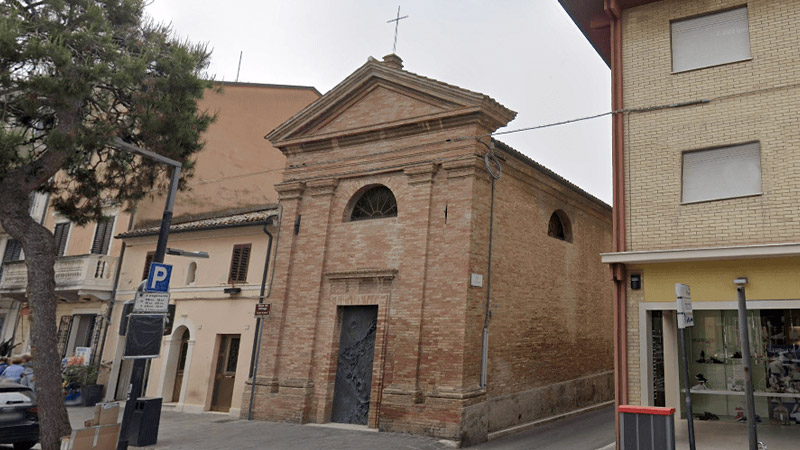
Porto Recanati – Church of Suffrage

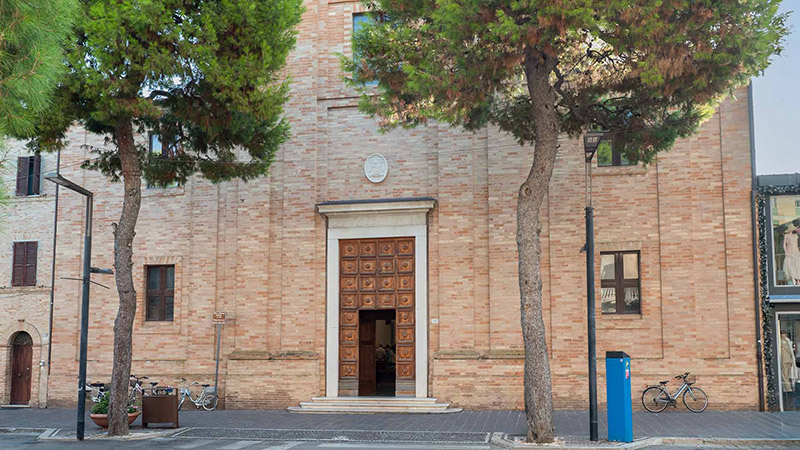
Along Corso Matteotti stands the Church of Suffragio, a Baroque-style building marked by turbulent times: first closed and abandoned, then used as a grain warehouse, and later, in 1713, reconsecrated and dedicated to the celebration of suffrage masses for the deceased. Inside, on the altar, there is an ancient canvas depicting the Virgin of Sorrows in glory, seated on a cloud with her heart pierced by seven swords: she is surrounded by three angels’ heads. To her right is Saint Andrew the Apostle, patron saint of fishermen, holding the X-shaped cross, symbol of his martyrdom, in his left hand and a grey mullet in his right. To his left is Saint Francis of Paola, and in the center is an angel holding a coat of arms with the inscription Charitas (motto of the order of Minims founded by the Saint). Below him is a lamb with a staff in its mouth, with which the Saint performed numerous miracles. Flanking the lamb, the Souls in Purgatory, amidst the flames, stretch out their arms toward the Virgin to be freed from their torments. The wooden altar on a lectern, the processional cross, the two lampposts, the two shrines of the Sacred Heart and Saint Joseph, and the two altarpieces on the side walls with the statues of Saint Anthony and Saint Rita are works by the master artist Raffaele Muzi, while the paintings of the Sacred Heart, Saint Joseph, and Padre Pio are by the Ancona-born painter Antonio Di Pietro. Outside, the bronze door was created by the artist Cecco Bonanotte.

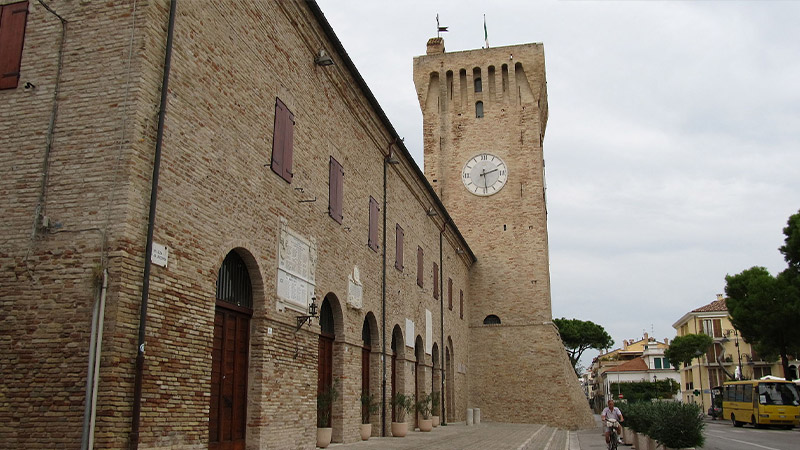
Porto Recanati – The Swabian Castle

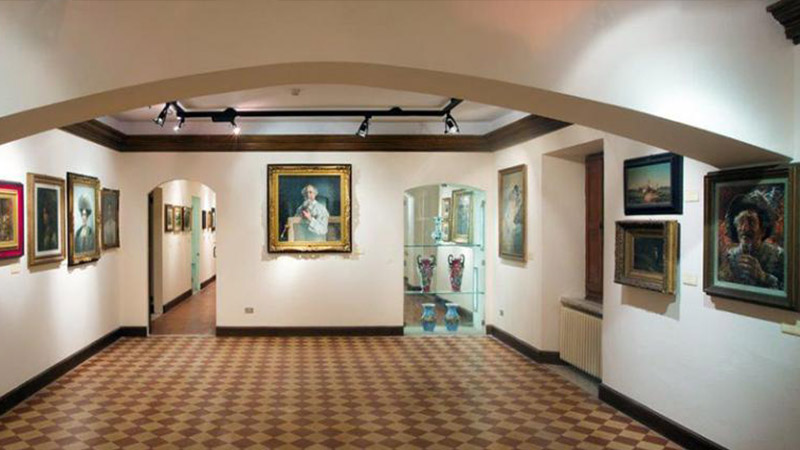
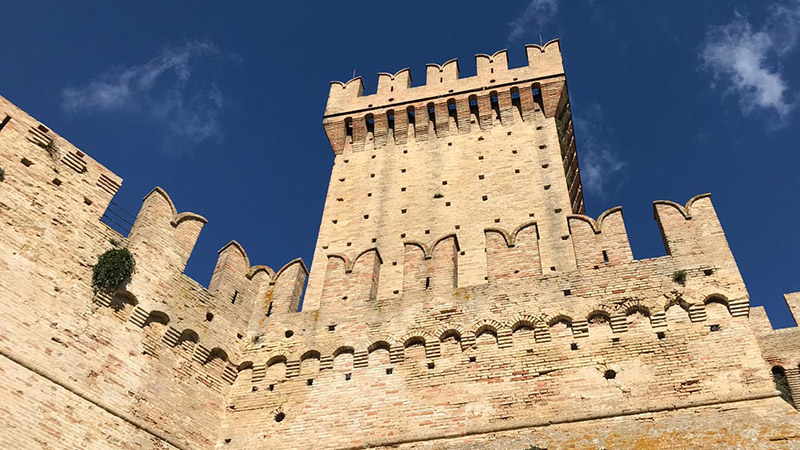
Located in the main square of Porto Recanati, the medieval castle takes its name from Frederick II, King of Swabia, who donated the lands on which the municipality of Recanati stands in 1229. It was built in the 13th century to protect the Recanati coast from pirate raids, especially the Turks. The first city center developed around the castle, and the interior of its walls became the space where the local population’s daily interactions took place. The main tower, originally quadrangular in plan, now octagonal, was erected before the entire fortification, while the second tower was built around 1400. A patrol path used for guarding and protection from above is visible along the entire wall. The large courtyard currently houses the “B. Gigli” arena, named after the famous tenor from Recanati, which hosts a wide range of cultural events during the summer season. On the first floor of the Castle it is possible to visit the Municipal Art Gallery which houses works collected by the illustrious fellow citizen Attilio Moroni (1909 – 1986), historic rector of the University of Macerata, jurist and art enthusiast; the entrance hall is instead dedicated to the Porto Recanati painter Biagio Biagetti (1877 – 1948).

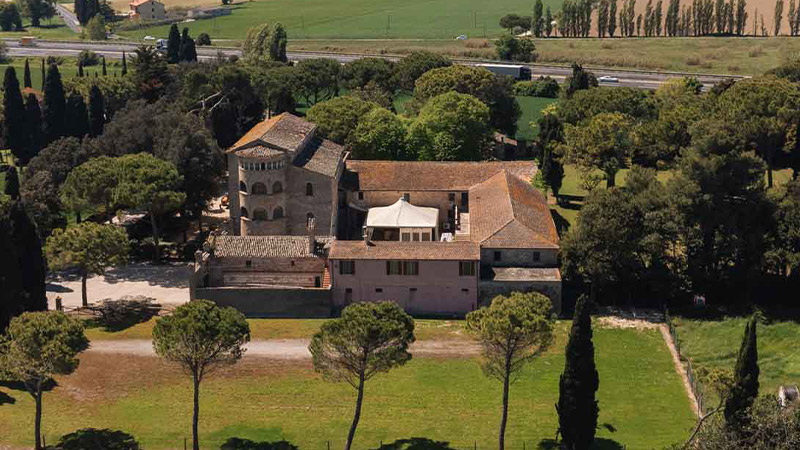
Porto Recanati – Abbey of Santa Maria in Potenza

The Abbey of Santa Maria in Potenza stands in the southern part of the Porto Recanati area and is one of the local churches with the richest history. The abbey church is a massive, unadorned building, featuring a semicircular avant-corps topped by a series of small columns and arches, typical elements of the Romanesque style. On the north side of the church, a very large room remains, now used as a warehouse, which was probably the monks’ former refectory. The abbey was founded by the Crociferi monks in the 11th century. These monks offered free shelter to the sick, hosting pilgrims and wayfarers. They also renovated roads and built bridges to facilitate access to their abbey. In 1656, the Crociferi’s work ceased due to the end of their order, decreed by a papal bull of Alexander II, and the abbey became the abbey. In the following years, by order of the Supreme Pontiffs, the abbey became the property of various ecclesiastical prelates, and its once fertile lands turned into marshy, malarial areas. In 1794, the abbey was granted by Pius VI to the Cistercian monks, who restored it to its former splendor and rebuilt the church from scratch. After a few years, however, the abbey was seized by Napoleon, who gave it as a gift to his sister Pauline, who was married to Prince Borghese. She never cared for it, and after her death, it became the property of her husband’s family. It was subsequently purchased by the current owners, who completely restored it and, in 1946, built a small chapel inside the crypt beneath the presbytery of the original church. The altar was adorned with a triptych, the work of the painter Prof. Cesare Peruzzi, which depicts the Madonna, to whom the abbey has always been dedicated, Saint Bernard, founder of the Cistercians, and Saint Anthony the Abbot, patron saint of these countryside.

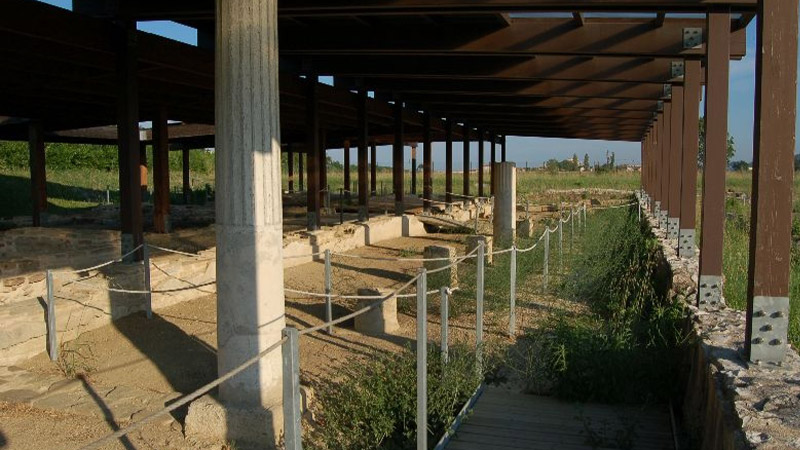
Porto Recanati – Archaeological Area of ​​“Potentia”

Just a few kilometers separate the current town of Porto Recanati from its past, its origins. Traveling south along the SS 16 Adriatica, you can glimpse an archaeological site unearthed since the 1980s. Scholars have long known of the existence of the ancient Roman colony of Potentia, founded in 184 BC by the triumvirs Quintus Fabius Labeo, Marcus Fulvius Flaccus, and Quintus Fulvius Nobilior, as attested by written sources, particularly Livy. In 174 BC, the censor Flaccus initiated, with community funding, a program of public works that included the construction of the portico around the forum, the Temple of Jupiter, and the city walls. In 56 BC, the city was devastated by a violent earthquake, and so, in the following decades, reconstruction work began. On this occasion, the Domus was built, enriched with a series of black-and-white geometric mosaic floors and frescoed walls. During the same period, the porticoes around the forum and the taverns underwent their first major renovation. To the north, the market was rebuilt with herringbone terracotta flooring, a central well, and porticoes were added on the east and north sides. During the Julio-Claudian period, the city expanded beyond its previously occupied area: on the eastern edge of the urban fabric, a complex was built, partly residential and partly used for manufacturing. With the fall of the Western Roman Empire and the subsequent barbarian invasions, the city began its inevitable decline. Immediately after the war, aerial photogrammetry carried out by the Royal Air Force (RAF) confirmed the city’s decline. British discovered the presumed perimeter walls of the ancient colony, but only 40 years later – during some works to upgrade the Porto Recanati water network – did the first remains resurface and excavations began, which are still ongoing today.

Porto Recanati – The A. Moroni Art Gallery

The ‘A. Moroni’ Municipal Art Gallery in Porto Recanati was founded thanks to private collections. It was established by the Municipality of Porto Recanati following a donation from Professor Attilio Moroni, longtime Rector of the University of Macerata and a dedicated art collector. He collected numerous works from the 16th and 17th centuries, particularly Italian and foreign paintings from the 19th and early 20th centuries, creating one of the most important collections of modern art in the region. The Art Gallery is housed in the upper rooms of the Swabian Castle and is divided into seven rooms, the first of which is dedicated to the Porto Recanati painter Biagio Biagetti, a leading exponent of 20th-century sacred art, a member of the Pontifical Academy of Virtuosi del Pantheon, and director of the Vatican Art Gallery. One of the adjacent rooms displays precious 16th- and 17th-century canvases, including some particularly striking ones, such as those attributed to Carlo Maratta, Luca Giordano, Rosso Fiorentino, and Spagnoletto. The entrance hall features drawings and paintings, including those by Adolfo De Carolis, Domenico Morelli, Felice Casorati, and Remo Brindisi. The other rooms house paintings from the most important 19th-century Italian schools, such as the Tuscan School, the Roman School, the Venetian School, the Neapolitan School, and the Northern School. Of particular note are paintings by Irolli, De Pisis, Signorini, Mancini, De Nittis, Soffici, and Postiglione. These rooms are also adorned with sculptures, ceramics, and several antique vases. “A. Moroni” Municipal Art Gallery – C/o Castello Svevo – Piazza Brancondi – Porto Recanati – Tel. 0717591283 Follow us on Facebook…

Loreto – The Holy House

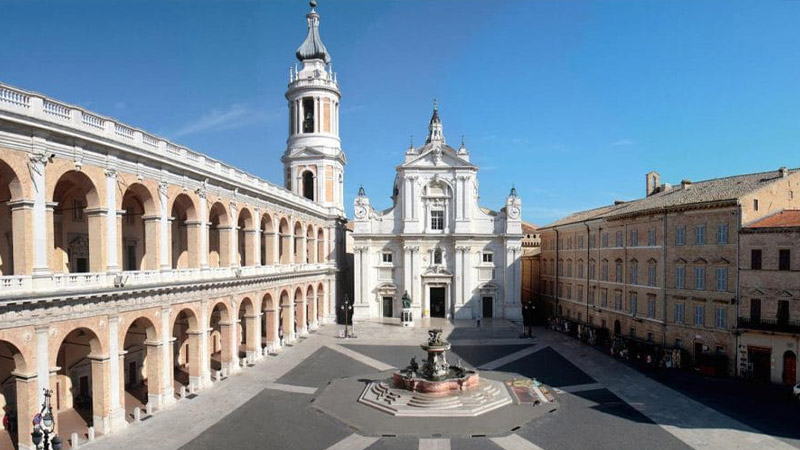
“The Holy House of Loreto is the first sanctuary of international importance dedicated to the Virgin and the true Marian heart of Christianity” (John Paul II). The Sanctuary of Loreto, in fact, preserves, according to an ancient tradition, now proven by historical and archaeological research, the house of Our Lady in Nazareth. According to tradition, in 1291, when the Crusaders were definitively expelled from Palestine, the masonry walls of the house of Our Lady were transported “by angelic ministry”, first to Illyria (to Trsat, in present-day Croatia) and then to the territory of Loreto (December 10, 1294). Today, on the basis of new documentary evidence, the results of archaeological excavations in Nazareth and in the subsoil of the Holy House (1962-65) and philological and iconographic studies, the hypothesis according to which the stones of the Holy House were transported to Loreto by ship, on the initiative of the noble Angeli family, who reigned over Epirus, is increasingly confirmed.

Recanati – Leopardi Palace

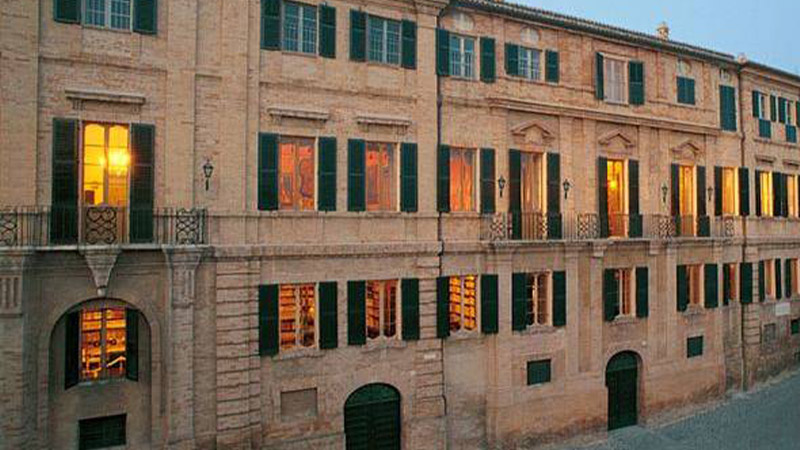
The Leopardi Palace in Recanati overlooks the small square named after Giacomo Leopardi’s famous poem, “The Village Saturday.” The library houses more than 20,000 volumes, most of which were collected and organized by Monaldo Leopardi, Giacomo’s father. The library’s current layout does not fully reflect its original layout, but was dictated by the need to comply with current safety regulations. The arrangement of the volumes and mementos, however, has remained unchanged since its founding, as attested by the cataloging cards compiled by Monaldo and his sons. The library is now accessed through several rooms where, in recent times, critical essays on Leopardi were and still are housed, as well as editions and translations of Giacomo’s works.

Monte Conero Regional Park

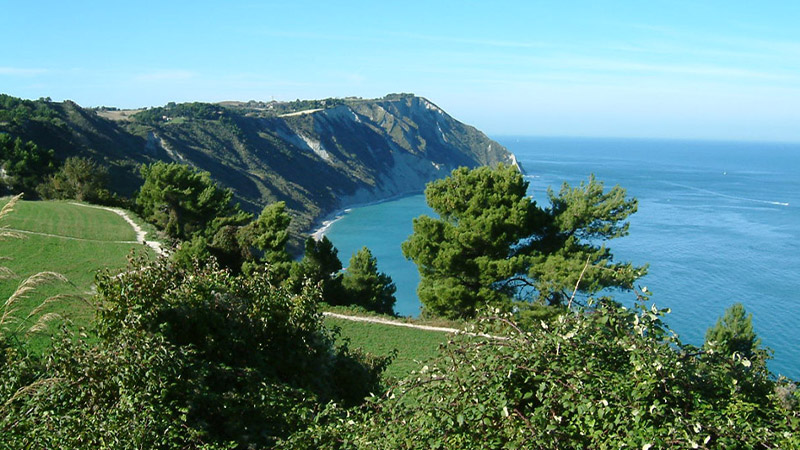
An environmental oasis formed around Mount Conero: 572 meters of Mediterranean scrub overlooking the sea. Established in 1987, the park is a protected area where you can hike along the 18 trails that wind through the woods, alone or accompanied by expert guides (Forestalp and Franca Silvia Di Cicco), observe the passage of migratory birds such as the peregrine falcon and nocturnal birds of prey, and visit precious historical and artistic sites, such as the Watchtower and the Romanesque church of Santa Maria in Portonovo Bay.

Offagna – Medieval Festivals

Offagna, a typical medieval village, nestled like a jewel between the green hills of the Marche region and the blue reflection of the sea off the nearby Conero Riviera, stands majestically with its fortress, positioned like a sentinel. This municipality boasts a centuries-old history, taking its name from the noble Roman Afrani family. The historical reenactment, known by the Offagnans as the “Contesa della Crescia,” draws its origins from the appendix of the Osimani statutes and the Statutes of Offagna. “Universis et singulis nostri Comitatus Vicariis Prioribus et Defensoribus salutem et obediantiam mandatorum nostrarum.” We send you an order made by our Magnificent Council on June 29, 1485, which, under penalty of our arbitrary will, we wish you to have proclaimed and notified to the men of our Castles and to observe for perpetual record, to have it written in your statutes ex nostro Palatio die quarta mensis julii millesimo quatragesimo axtuagessimo quinto. The Magnificent and General Council of the authority and Balia of the illustrious City of Ancona has absolutely and solemnly ordered and reformed that every year at least once each castle of its County listed on the day of the principal feast of the place shall have a prize and price drawn by the crossbowmen as determined below, so that its said feast is more honored by exercising the said crossbowmen and so it was ordered notwithstanding anything to the contrary. Sirolo, Cammorano, Offagna, Varano, Polverisi, Gugliano, Monte Santo Vito, Castel di Milo, Price of a gold ducat. L. Cancellarius

Mia Clubbing - Porto Recanati

A new dimension of entertainment is born, a location completely renovated in every aspect and ready to launch onto the market with a very different and certainly innovative concept for the nightlife world. Mia Clubbing, in Porto Recanati (formerly Lola), is completely new, now owned by the Guazzotti family. A new team has been created, the greatest professionals in the nightlife world united with a successful entrepreneurial group, a single project, to offer a fun and innovative product. Human resources, ideas, and major investments are thus taking shape Mia Clubbing, a sure protagonist of the next autumn season, a venue already considered by industry insiders to be unique in Italy. The project was born from the new owners’ desire to blend the best of the world into a single design. Hence the implementation of a project inspired by the designers and architects who created the Cavalli Club and Armani Privèe Dubai and Amnesia Ibiza. The Mia Clubbing style will encompass all the best of these international venues. The cutting edge technology and special effects have been chosen. The public is eagerly awaiting this new facility, which promises to be one-of-a-kind and surprising in every aspect. Cutting-edge sound, light, and color are the hallmarks of this new experience. Even more innovative is the Mia Show Restaurant, featuring a new Dinner Show format inspired by Miami’s finest venues.

Accessibility Toolbar